
Prof. Dr. Leo Brecht


Member of the Board, Partner


Prof. Dr. Leo Brecht
Member of the Board, Partner
Prof. Dr. Leo Brecht is a mathematician and economist with a PhD in mathematical statistics and a professorship in innovation and technology management at the University of Liechtenstein. With over 20 years of experience in management consulting and applied research, and more than 10 years in investment management, he is a leading expert in the fields of innovation, technology and product management. Leo Brecht has supported more than 100 projects for SMEs and multinational companies in various industries, from strategic consulting to technology assessments. He is also the founder of ALPORA, where he and his team have developed innovative investment products that have led to over €700 million in assets under management. Over the last ten years, he has given more than 1,000 investor presentations. He was a partner at Andersen and Arthur D. Little, the author of several books and a conference speaker. As an active investor and serial entrepreneur, he is particularly involved in the FINTECH, SUSTTECH and EDUTECH sectors. In his free time, Leo Brecht is a passionate regatta sailor and skier and enjoys spending time with his family.
This article is part of a twelve-part series exploring where corporations can achieve productivity gains. This installment, Lever 11 of 12, looks at product development and time to market. The full series is available here.
A new automated lighting fixture that once took sixteen weeks to design can now be developed in two. That figure—an 87 percent reduction in design time, reported by EatonCorporation in an official case study published by the manufacturing-insights platform aPriori—is one of the more striking single-company productivity claims documented across this twelve-part series. It is also a useful entrypoint into a broader question that matters to anyone studying how companies translate technology into measurable operating performance: what happens when product development stops being a sequential, time-constrained process and becomes a parallel, exhaustive one?
A Lever with a DoubleEffect
Most of the productivity levers in this series deliver value through one primary channel—lower cost, higher throughput, or reduced risk. Product development is one of the few domains where two effects occur at once. The first is cost reduction: generative designsoftware explores far more of the possible design space than a humanengineering team could draft by hand within a normal project timeline, which reduces the number of failed iterations and wasted simulation cycles. The second is revenue acceleration: a shorter design cycle means an earlier market launch, which compounds the first effect rather than merely adding to it.
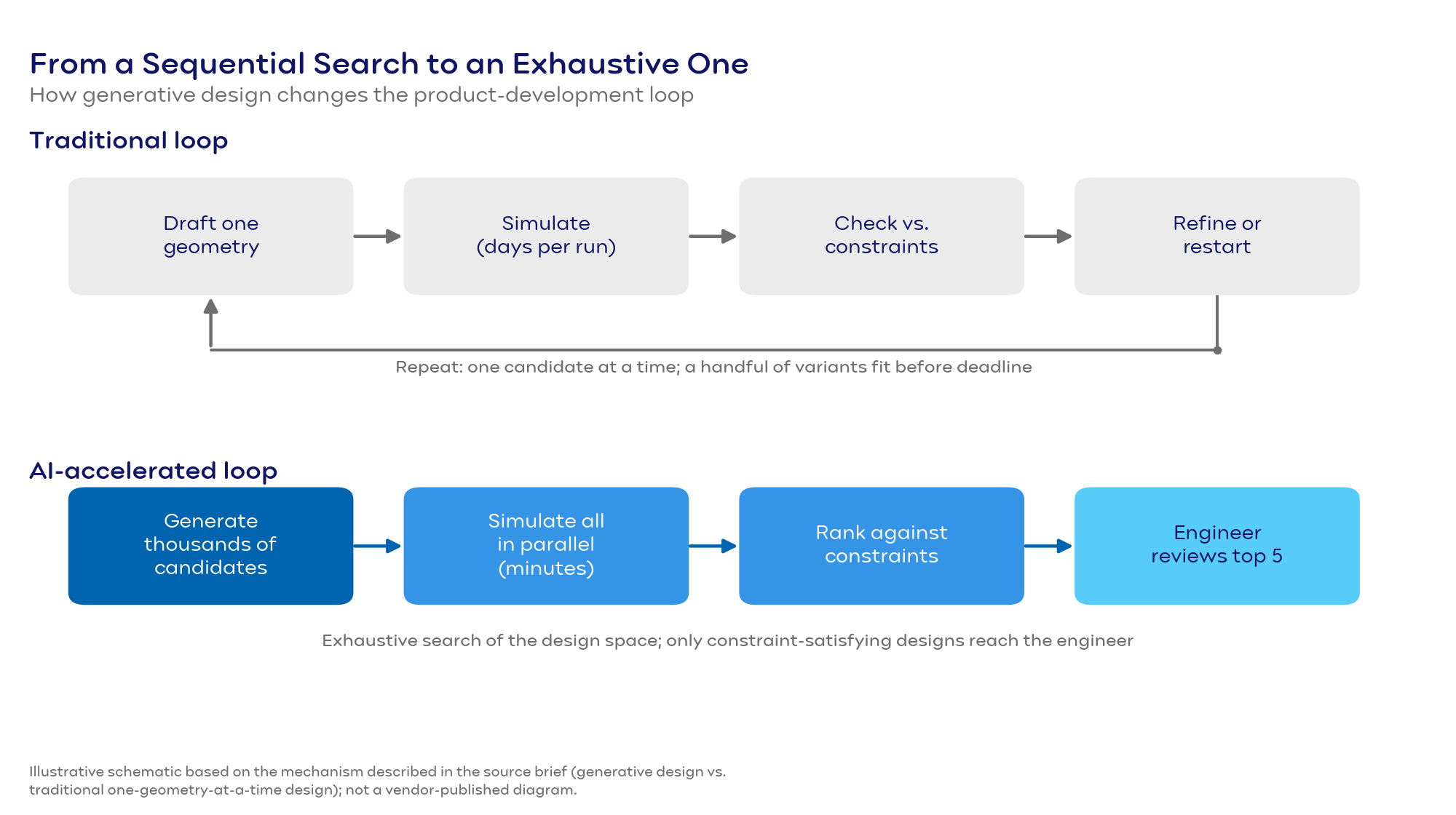
The underlying mechanism is a shift in how the design process itself works. A traditional workflow tests one geometry at a time. Each physics simulation—checking whether a part meets weight, strength, or cost requirements—can take days on a computing cluster, which is why a real product typically only gets to explore a handful of design variants before a deadline forces a decision. Generative design inverts that constraint. Instead of drafting one geometry and testing it, the software proposes thousands of manufacturable candidates against multiple constraints simultaneously, simulates them in parallel, and presents engineers with only the handful of designs that already satisfy every requirement. The process does not just speed up a known design to draft—it searches a design space a human team would never have had time to consider in the first place.
The Technology in PlainTerms
The visually striking, organic-looking parts produced by generative design software tend to get most of the public attention, but the productivity gain in this domain is delivered by a wider toolkit that spans several distinct techniques:
- Generative design and topology optimization—software that generates thousands of manufacturable design candidates against weight, strength, and cost constraints at once, then ranks them so engineers only review the few worth considering.
- AI-assisted product-management tooling—systems that speed up the surrounding work of specification writing, roadmap prioritization, and stakeholder communication that determines what gets designed in the first place.
- AI-powered recipe and formulation generation—the same generative logic applied to food science and consumer goods, compressing formulation cycles that traditionally relied on manual trial and error.
- Algorithmic design for additive manufacturing—AI-native tools purpose-built for 3D-printable geometries, such as graded lattice structures, that conventional CAD software cannot represent because it was built around subtractive and molded manufacturing rather than layer-by-layer printing.
Three Companies Already Using It
The documented results extend across very different industries, which is itself notable: the mechanism appears to generalize rather than being specific to one sector.
Eaton Corporation, a $23.2 billion intelligent power-management company headquartered in Dublin, integrated generative AI into its product-design process using data from Priori to model designs for cost, manufacturability, and sustainability. Beyond the 87 percent reduction in lighting-fixture design time, the same program cut the weight of a liquid-to-air heat exchanger by 80 percent and reduced the design time for a high-speed gear by 65 percent. Eaton has stated it is aiming to double the output of its new-product innovation investments as a result.

Mondelez applied a comparable generative approach to food science rather than mechanical engineering. According to Wall Street Journal reporting, an AI-powered recipe-development tool accelerated new product development four to five times, contributing to the launch of 70 new snack products—including the Gluten-Free Golden Oreo—alongside a reported 5.4 percent increase in sales. The example matters because it proves that the generative-design mechanism observed at industrial manufacturers applies just as well to consumer packaged goods.
Renishaw and Irish Manufacturing Research, working with nTop's implicit-modelling and lattice-generation platform, designed patented graded-lattice structures for spinal implants—geometries that conventional CAD software cannot represent because they require continuously varying internal cell structures tuned to the mechanical properties of surrounding bone. This case is categorically different from the other two: rather than accelerating a design process that could already be done manually, it enables a class of medical-device geometry that was not previously designable at all.
A Narrower Venture Landscape than Most
For anyone mapping the technology and start-up landscape behind this productivity lever, product development stands out as one of the narrower fields in the series. Independent venture activity is concentrated in two of the five technique families described above.
nTop anchors generate design and topology optimization. The company has raised $135 million, reached a $400 million valuation, and its implicit-modelling technology is used across aerospace, automotive, and medical-device design. Its February 2025 acquisition of computational-fluid-dynamics specialist cloudfluid is also noteworthy in its own right: a venture-backed leader consolidating adjacent capability, rather than being acquired itself—a less common pattern than the reverse.
Hyperganic, the Munich-based pioneer of voxel-engine-based component design, has used its “Hyperganic Core” engine to generate a fully AI-designed, single-block 3D-printed rocket engine. It has raised comparatively modest capital relative to the scale of what its technology enables, suggesting that algorithmic design for additive manufacturing has not yet attracted the scale of investment seen in mechanical generative design more broadly.
Uizard applied the same generative logic to UI and UX prototyping, converting product specifications and sketches directly into functional prototypes. It raised $18.6 million before being acquired by collaborative-whiteboard company Miro in 2024—a completed exit that folded generative product-design capability into a much larger collaboration platform.
Two of the five technique families—AI-assisted product-management tooling and AI recipe generation—show no independent venture leader at all. Both capabilities are increasingly built directly into existing product-management suites or developed in-house by large consumer-goods companies rather than sustaining stand-alone start-ups. This is itself a relevant data point for anyone assessing where defensible, investable technology actually sits in this domain.
What This Means for Investors
The pattern across Eaton Mondelez and the Renishaw/Irish Manufacturing Research /nTop collaboration is consistent: replacing a slow, one-geometry-at-a-time design loop with a fast, AI-generated one that tests thousands of candidates in parallel collapses the time from design brief to manufacturable part. For capital allocators studying productivity as an investment theme, product development illustrates a recurring point from this series—the gains are real and documented at named companies, but they vary by what is measured (design time, component weight, or overall development speed) and should be read as reported outcomes from specific deployments rather than general industry averages.
