
Prof. Dr. Leo Brecht


Member of the Board, Partner


Prof. Dr. Leo Brecht
Member of the Board, Partner
Prof. Dr. Leo Brecht is a mathematician and economist with a PhD in mathematical statistics and a professorship in innovation and technology management at the University of Liechtenstein. With over 20 years of experience in management consulting and applied research, and more than 10 years in investment management, he is a leading expert in the fields of innovation, technology and product management. Leo Brecht has supported more than 100 projects for SMEs and multinational companies in various industries, from strategic consulting to technology assessments. He is also the founder of ALPORA, where he and his team have developed innovative investment products that have led to over €700 million in assets under management. Over the last ten years, he has given more than 1,000 investor presentations. He was a partner at Andersen and Arthur D. Little, the author of several books and a conference speaker. As an active investor and serial entrepreneur, he is particularly involved in the FINTECH, SUSTTECH and EDUTECH sectors. In his free time, Leo Brecht is a passionate regatta sailor and skier and enjoys spending time with his family.
Research and development were long regarded as the least measurable business process. The 2024 Nobel Prize in Chemistry awarded to the AlphaFold team has changed this perception: AI is now recognized as a scientific tool in its own right, not merely an efficiency add-on. This article clarifies what documented, verifiable evidence actually exists—and what is (still) an unproven assumption or extracted claim.

A Nobel Prize as a turning point
Productivity gains can be gauged by unit output in manufacturing and by turnaround times in administration. In research and development, this has historically been virtually impossible: the output of a research program—a discovery, a discovery, a patent, a clinically effective drug candidate—cannot simply be counted as a transaction volume. This assessment has changed, though not as a result of a productivity study, but through one of the highest scientific honors: the 2024 Nobel Prize in Chemistry was awarded to the team behind AlphaFold, thereby formally confirming that artificial intelligence is a fundamental tool of molecular science—and not merely an additional layer of efficiency superimposed on existing research.
For institutional investors seeking structural efficiency potential within companies, this is more than just a footnote in the scientific literature. It marks the point at which a corporate process that was previously almost impossible to quantify can, for the first time, be described using comprehensible time and outcome metrics.
Why research has been so difficult to accelerate
A traditional research program is iterative: a researcher proposes a candidate structure, synthesizes it, tests it, and waits weeks for a result before the next experiment begins. This process scales with staff and time, not with computingpower . AI-supported methods are changing precisely this limitation: a model can use computers to suggest and evaluate thousands of candidates before even one of them reaches the laboratory. According to the underlying dossier, the most robust published results in this field show a reduction in development time of between 60 and 95 percent—significantly more than is usual in many other process optimizations.
It is important to note that, particularly in this field, the evidence must be examined with particular care. A widely cited 2024 study, which claimed to provide randomized-controlled-trial-based evidence of a 44 percent increase in AI-assisted material discoveries, was formally retracted by MIT in May 2025 after an internal review found no basis for the origin of the data—the authors said they had completely fabricated the underlying dataset. This article therefore deliberately relies solely on peer-reviewed clinical publications, named company statements, and verifiable funding data—a narrower but more reliable evidence base.
The toolkit: four building blocks
Generative molecular design attracts the most public attention, but the real productivity gain stems from a broader toolkit :
- Generative molecular and material design: AI systems propose novel drug or material candidates directly from a target property, thereby tapping into a significantly larger chemical or structural search space than intuition-driven research can achieve.
- Self-driving labs/closed discovery loops: Robot-assisted experiments are combined with AI-driven experimental design so that synthesis, testing, and feedback take place without human intervention at every single step—entire iterative laboratory cycles are eliminated, rather than merely being sped up.
- AI-assisted literature synthesis: Language models reduce the time spent on literature searches by filtering out the genuinely relevant results from a volume of publications that no human could read in full.
- Protein and molecular structure prediction: Models in the AlphaFold lineage predict the three-dimensional structure of a molecule from sequence data with near-experimental accuracy—a problem that had remained unsolved for fifty years.
Robust figures—and their limitations
Three examples from the dossier illustrate what has actually been documented to date:
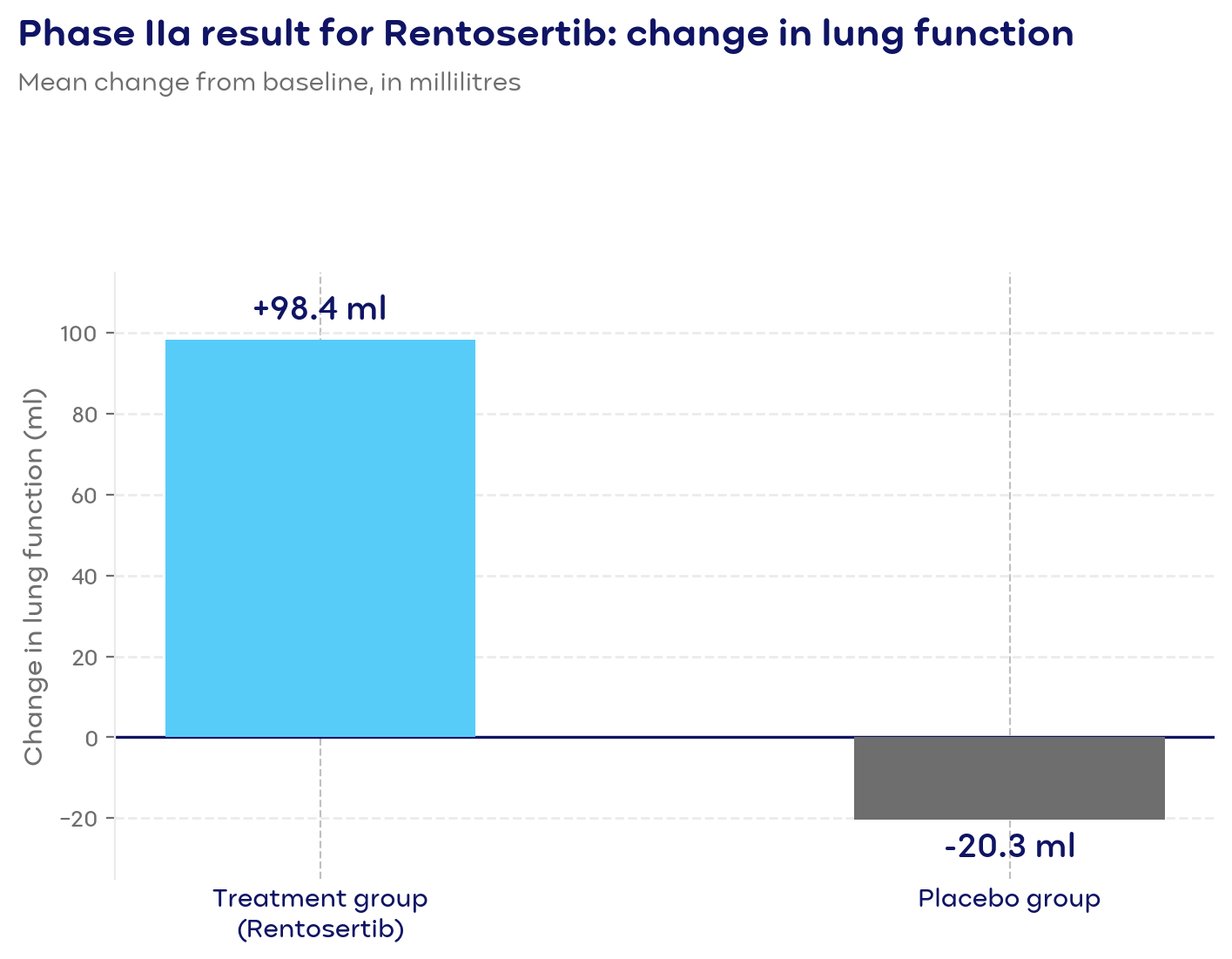
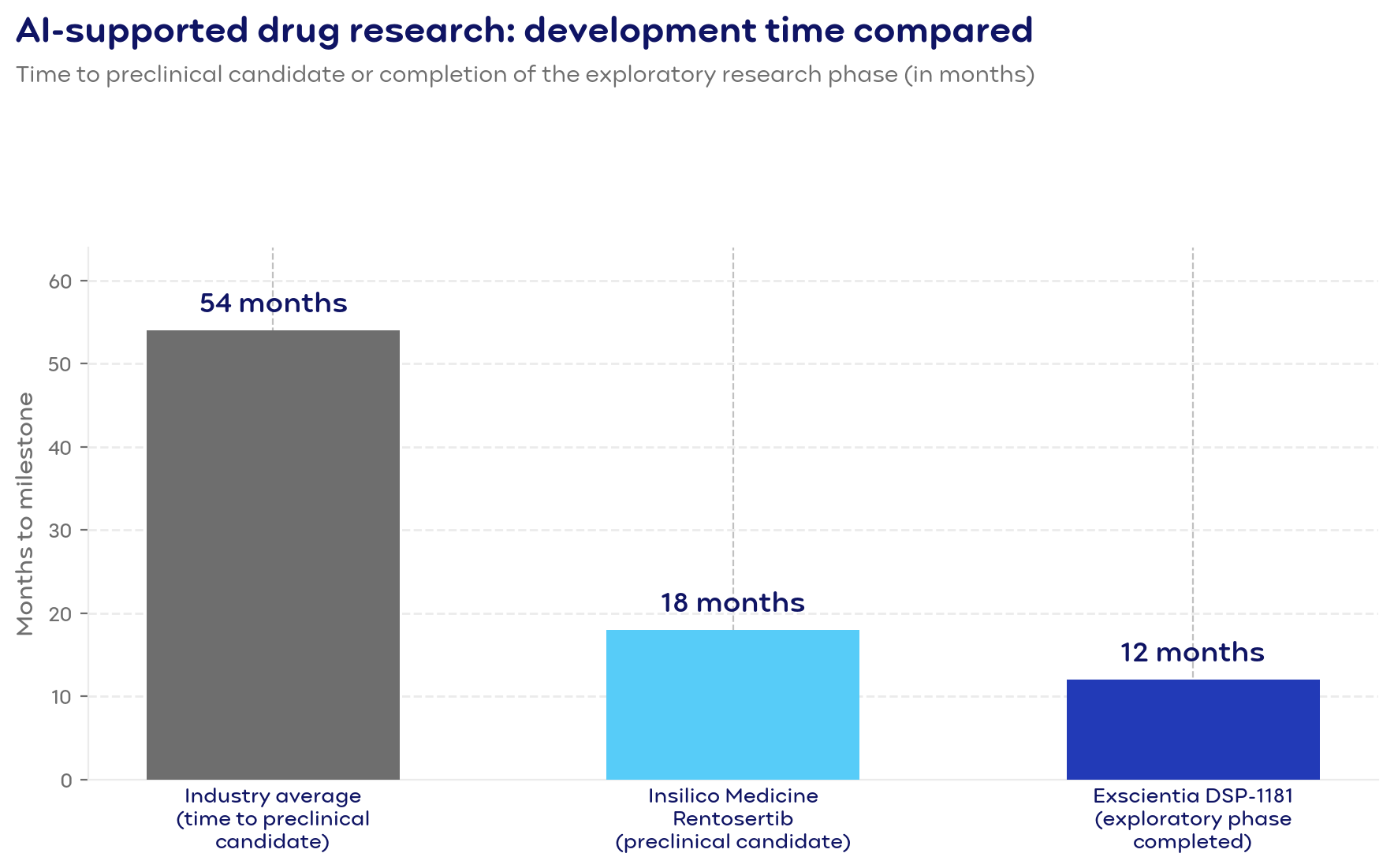
- In silico Medicine – Rentosertib: The first published drug candidate in which both the target molecule and the active substance were identified using AI. The program achieved the designation of a preclinical candidate in around 18 months, compared with an industry average of around 4.5 years. The Phase IIa results, published in June 2025 in the journal NatureMedicine, showed a mean improvement in lung function of 98.4 milliliters in the treated group, compared with a mean decline of 20.3 milliliters in the placebo group. Rentosertib entered Phase III trials in 2026.
- Exscientia – DSP-1181: Developed in collaboration with Sumitomo Dainippon Pharma, this program completed the exploratory research phase in under twelve months, compared with an industry average of 4.5 years – although Sumitomo subsequently discontinued the program. This is an important reminder: faster discovery does not guarantee clinicalsuccess .
- Sanofi: With a collaboration and licensing agreement with Exscientia worth up to US$5.2 billion in milestone payments for 15 candidate molecules, as well as separate partnerships with Atomwise and Insilico Medicine, Sanofi has built one of the industry's broadest AI R&Dstrategies .
According to the dossier, these figures are taken from peer-reviewed publications or publicly reported corporate milestones, not from unsubstantiated industry estimates. Nevertheless, it remains the case that individual results from pharmaceutical research cannot be directly extrapolated to every sector or every company, and a shorter development cycle is not evidence of higher commercial or clinical success rates.
How the venture landscape is being reshaped
The sector has already seen one of the largest consolidations documented in the dossier: in 2024/2025, Recursion Pharmaceuticals acquired its competitor Exscientia in an all-stock transaction worth around US$688 million, thereby combining extensive cellular imaging data with an AI design platform and a clinical pipeline . At the same time, the sector is characterized by very high capital intensity. Isomorphic Labs, the spin-off from DeepMind, has raised US$2.68 billion, including a US$2.1 billion Series B round—while still reporting no productrevenue . Schrödinger, by contrast, has taken a different path as a listed company (NASDAQ: SDGR), offering investors rare direct public-market access to computer-aided molecular design.
Guidance for institutional investors
The mechanism outlined here—whereby a slow, sequential process is replaced by computer-assisted preliminary testing of thousands of hypotheses—is an example of how structural efficiency potential can arise and become apparent within companies. For the assessment of individual companies or ventures, this means that what matters is not the announcement of an AI strategy, but whether documented, verifiable, and repeatable results can be derived from it—and whether faster development actually leads to robust clinical or commercial outcomes.
This article describes an investment approach and an analytical perspective; it does not constitute individual investment advice, an investment recommendation, or a guarantee of future results. Historical or model-based results are not a reliable indicator of future performance.
Part of a wider series
This article is part of the Averdas series on the areas in which companies can achieve productivity gains today. The series examines a total of twelve different areas—ranging from operational processes to strategic research and development. You can find the overview here: Where Corporates Can Achieve Productivity Gains.
