
Prof. Dr. Leo Brecht


Member of the Board, Partner


Prof. Dr. Leo Brecht
Member of the Board, Partner
Prof. Dr. Leo Brecht is a mathematician and economist with a PhD in mathematical statistics and a professorship in innovation and technology management at the University of Liechtenstein. With over 20 years of experience in management consulting and applied research, and more than 10 years in investment management, he is a leading expert in the fields of innovation, technology and product management. Leo Brecht has supported more than 100 projects for SMEs and multinational companies in various industries, from strategic consulting to technology assessments. He is also the founder of ALPORA, where he and his team have developed innovative investment products that have led to over €700 million in assets under management. Over the last ten years, he has given more than 1,000 investor presentations. He was a partner at Andersen and Arthur D. Little, the author of several books and a conference speaker. As an active investor and serial entrepreneur, he is particularly involved in the FINTECH, SUSTTECH and EDUTECH sectors. In his free time, Leo Brecht is a passionate regatta sailor and skier and enjoys spending time with his family.
This report compiles quantified productivity gains from AI adoption across 12 corporate process domains, drawn exclusively from named primary research—McKinsey, BCG, Gartner, Deloitte, PwC, the US Department of Energy, Siemens, IBM, and peer-reviewed academic studies. Each figure is traceable to a specific study, its methodology, and (where disclosed) its sample size, so the numbers can be assessed for reliability and relevance to a given business context.
40% - Average employee productivity boost — AI-assisted work (Gartner / controlled enterprise trials)
25% - Total cost reduction from end-to-end AI integration (McKinsey Global Institute, 2025)
57% - Share of corporate work hours automatable today (McKinsey Automation Report, Nov 2025)
Headline Gains by Process Domain
Each row shows the single most robust headline figure for a domain, plus a secondary metric and the primary source underpinning it. These are outcomes reported by actual adopters, not projections.
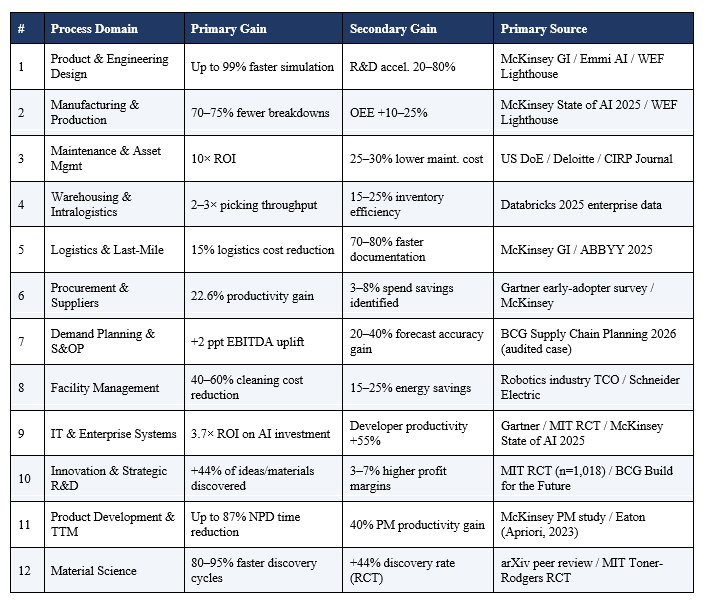
The 12 Process Domains
1. Product & Engineering Design
AI-native surrogate models replace HPC-based simulation, cutting simulation time by up to 99% and accelerating R&D 20–80% depending on the sector (McKinsey GI). Digital twins cut planning cycles ~30% (NVIDIA/WEF, n=189 lighthouse factories), and generative design cuts physical prototyping needs 40–60% (Siemens/PwC).
2. Manufacturing & Production Operations
AI visual inspection achieves 90%+ defect detection; OEE improves 10–25%; ML adopters are 3× more likely than non-adopters to hit KPI targets (McKinsey State of AI 2025, n=1,993 organizations). 72% of manufacturers surveyed by NAM (2025) report reduced costs after adopting AI.
3. Maintenance, Repair & Asset Management
The best-documented ROI case in industrial AI: 70–75% fewer unplanned breakdowns, 25–30% lower maintenance expenses, and 10× ROI, consistent across US DoE,Deloitte, IBM, and a peer-reviewed 80-study meta-analysis (CIRP Journal, 2024).
4. Warehousing &Intralogistics
Picking represents 55–65% of warehouse operating expenses. AI-guided picking cuts errors up to 67% and lifts throughput 2–3×; AI forecasting improves inventory efficiency 15–25% (Databricks, 2025, enterprise-wide deployment data).
5. Logistics, Transport & Last-Mile Delivery
McKinsey estimates AI can cut total logistics costs 15% via routing, carrier selection, and load-planning optimization. Freight document processing time falls 70–80% (ABBYY, 2025); autonomous last-mile delivery can run 40–60% cheaper than human delivery.
6. Procurement & Supplier Management
60–80% of routine procurement actions can now run without human approval in mature deployments. Gartner's early-adopter data shows 15.2% cost savings and 22.6% average productivity improvement; payback is typically 6–18 months.
7. Demand Planning, Inventory & S&OP
BCG's 2026 supply chain planning survey documents a +2 percentage-point EBITDA improvement at a global industrial goods company from embedded agentic AI in S&OP. Databricks data shows 20–40% forecast accuracy gains and 20–30% reductions in excess/obsolete inventory.
8. Facility Management & Corporate Real Estate
Autonomous cleaning robots cut service costs 40–60%; AI building-management systems save 15–25% on energy (Schneider Electric's Le Vaudreuil factory: 25% energy reduction, 17% material-waste reduction). JLL occupancy analytics enable a 15–20% real estate footprint reduction.
9. IT, Software Development & Enterprise Systems
GitHub Copilot controlled trials (including an MIT 3-company RCT at Microsoft, Accenture, and a Fortune 100 firm) show 30–55% developer productivity gains. Gartner finds 40% less time on routine IT maintenance; end-to-end AI integration cuts IT costs up to 25%, with a 3.7× ROI per dollar invested in integrated deployments.
10. Innovation & Strategic R&D
A landmark MIT RCT (Toner-Rodgers, 2024, n=1,018 scientists) found AI-assisted researchers discovered 44% more materials and filed 39% more patents, automating 57% of idea-generation tasks. AI-enhanced new products drive 6–10% higher sales (Cooper & Brem, 2024); AI leaders show 3–7% higher profit margins than followers, a gap McKinsey expects to widen to 8–15% by 2027.
11. Product Development & Time to Market
McKinsey's study of product managers found a 5% acceleration in software time-to-market and a 40% PM productivity gain. Eaton Corporation's generative-design deployment cut new product design time by up to 87% — the most dramatic single-company case in the literature.
12. Material Science & Advanced Materials
Closed-loop AI workflows cut materials-discovery time 80–95% versus conventional approaches (arXiv, 2022). AlphaFold's protein-structure breakthrough (2024 Nobel Prize in Chemistry) expanded the structural database from thousands to 200M+ structures, validating AI as a foundational material science tool.
Cross-Cutting Insights
- Workflow redesign is the single biggest driver of AI impact on EBIT (McKinsey). Companies that bolt AI onto legacy processes without redesigning workflows typically capture less than 5% of potential value.
- Only about 6% of organizations qualify as "AI high performers" generating 5%+ EBIT impact (McKinsey, 2025, n=1,993); the gains cited throughout this report reflect that high-performer cohort, not the average adopter.
- Predictive maintenance (Domain 3) has the most extensively corroborated ROI of any AI use case, with converging figures from government, consultancy, industry, and peer-reviewed sources.
- High performers are nearly 3× more likely to cite innovation—not just efficiency—as their AI objective, and this correlates with superior revenue growth and market-share outcomes.
- Procurement AI has among the fastest payback periods (6–18 months) of any enterprise AI deployment because savings are directly measurable against baseline spend.
