
Prof. Dr. Leo Brecht


Member of the Board, Partner


Prof. Dr. Leo Brecht
Member of the Board, Partner
Prof. Dr. Leo Brecht is a mathematician and economist with a PhD in mathematical statistics and a professorship in innovation and technology management at the University of Liechtenstein. With over 20 years of experience in management consulting and applied research, and more than 10 years in investment management, he is a leading expert in the fields of innovation, technology and product management. Leo Brecht has supported more than 100 projects for SMEs and multinational companies in various industries, from strategic consulting to technology assessments. He is also the founder of ALPORA, where he and his team have developed innovative investment products that have led to over €700 million in assets under management. Over the last ten years, he has given more than 1,000 investor presentations. He was a partner at Andersen and Arthur D. Little, the author of several books and a conference speaker. As an active investor and serial entrepreneur, he is particularly involved in the FINTECH, SUSTTECH and EDUTECH sectors. In his free time, Leo Brecht is a passionate regatta sailor and skier and enjoys spending time with his family.
The product is created twice
Before an aircraft component, turbine part, or seat bracket is manufactured, it first exists in a digital world. There, engineers test how it behaves under load, how air or heat flows around it, and whether it meets requirements for weight, strength, and manufacturability.
This digital stage is no longer a minor preliminary step. It plays a major role in determining which products ultimately enter physical production. At the same time, it was a bottleneck for decades: depending on complexity, demanding physics simulations could take days or weeks. For reasons of time and budget, engineering teams, therefore, had to work with a limited number of variants. The problem was not necessarily a lack of ideas. It was the limited number of ideas that could be tested in time.
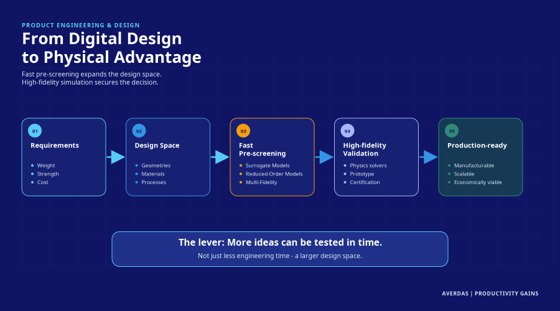
This is where the productivity lever, product engineering & design, begins. If digital tests become faster, less expensive, and more automated, companies can assess more variants before committing to one. That changes not only the speed of development. It can also improve the quality of the final product.
Why faster testing is more than an efficiency gain
A conventional development loop can be simplified as follows: An engineering team designs one variant, runs a simulation, reviews the result, and then revises the design. Each round consumes time, computing capacity, and specialist resources.
If a simulation takes several days, only a few iterations are realistic. The team must decide early which approaches to pursue. A design that is never tested cannot win—even if it would theoretically be the better solution. Faster models change this logic. They make it possible to assess many candidates in parallel and then test only the most promising solutions with high-fidelity methods. The process shifts from a linear sequence of individual attempts to a broader search across the design space.
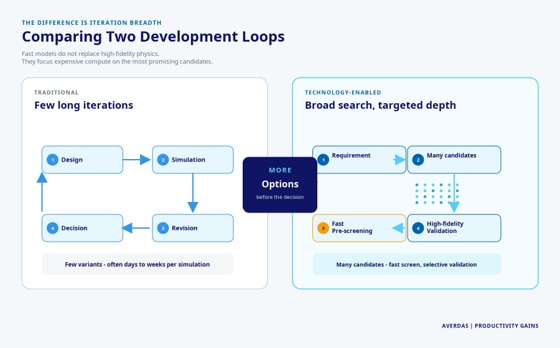
For companies, this can create several benefits:
- shorter development times, because more iterations can be completed within the same calendar period,
- better products, because more alternatives can be compared,
- lower material use, when shapes and structures can be optimized more precisely,
- fewer physical prototypes, if digital models become more reliable,
- greater adaptability, because product changes can be assessed more quickly.
The relevant point for investment analysis is that the technology does not merely reduce costs. It can change the economic production function of a company.
Five technology building blocks – five different investment logics
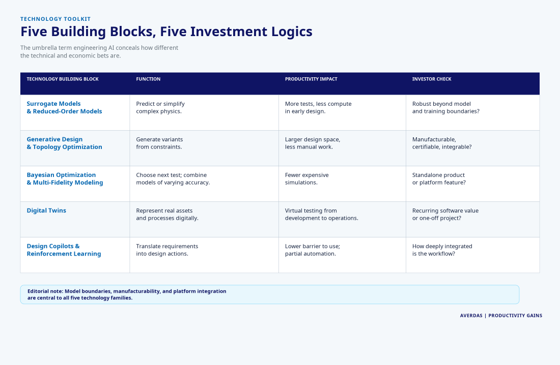
The market is often grouped under the term “AI forengineering.” Technically and economically, however, it comprises different approaches. For investors, this distinction matters because maturity, scalability, data dependence, and exit potential can differ significantly.
1. Fast surrogates for slow physics
Surrogate models learn from numerous previously calculated or measured cases. Instead of running a complete physics simulation again, the model estimates the result of a new design.
Neural networks are only one option. Gaussian process models can also indicate how certain a prediction is. Reduced-order models take a mathematical approach: They simplify a complex model while retaining its essential properties and removing less relevant detail.
For safety-critical industries, this distinction is fundamental. Speed alone is not enough. A model must also indicate when its prediction is uncertain and when a high-fidelity simulation or physical test is required.
2. When the computer suggests the shape
Generative design software does not start with a finished sketch. It receives objectives, constraints, and connection points—for example, the aim of minimizing weight while maintaining sufficient strength—and generates numerous variants.
Some methods use evolutionary algorithms. Others draw on newer generative models. The result can be an organic-looking structure that a human engineer would probably not have drawn by hand.
The economic benefit, however, depends on one crucial detail: a mathematically optimal design is not automatically a manufacturable product. Manufacturing technology, material availability, certification, and quality control must be incorporated into the solution.
3. The next test is a small-scale investment decision
Bayesian optimization and multi-fidelity modeling treat the development process as a sequence of selection decisions. Not every variant is tested with the same level of precision. Low-cost, lower-fidelity models are combined with a limited number of expensive, high-fidelity simulations.
The goal is not to calculate every possibility. It is to move toward a practical solution as quickly as possible within a limited compute budget. For investors, the question is whether these methods can form an independent software category or whether they will become features within larger design and simulation platforms.
4. Digital twins turn the lifecycle into a data model
A digital twin is more than a static 3D model. It is continuously updated with data from the real system—for example, a turbine, a production line, or an offshore asset.
This allows companies to test changes in the digital representation first. A maintenance schedule, process change, or new component can be simulated before the physical asset is altered.
The strategic value increases when the digital twin is used beyond product development: in operations, maintenance, capacity optimization, and planning additional assets.
5. Engineering copilots lower the barrier to use
Large language models are increasingly used as assistants for technical tasks. A text-based requirement can be translated into an initial specification, a script, or an action in an existing design environment.
This promises easier access to complex tools. It also changes the requirements for governance and validation. The more deeply a copilot intervenes in a development process, the more clearly it must be defined which decisions may be automated and where a qualified human must approve the result.
What can already be observed in industry
The source document names three corporate examples that illustrate different sides of the productivity lever. They are not directly comparable: each uses different measures, and the reported results refer to different baselines.
The examples show three different channels through which value can be transferred:
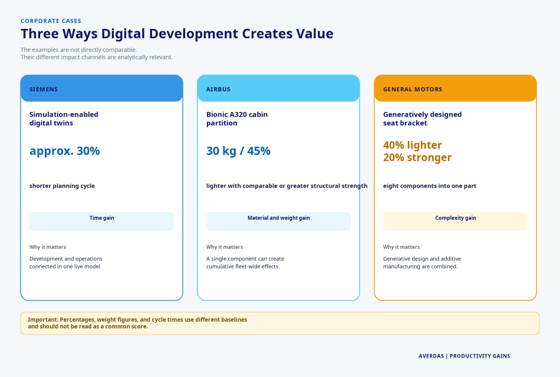
- Time gain: Processes become faster and can be repeated more frequently.
- Material and weight gain: The product becomes lighter or more resource-efficient while retaining its function.
- Complexity gain: Several components, worksteps, or variants are combined into an integrated solution.
For company analysis, the relevant question is therefore not only whether a company uses a particular software tool. What matters is whether the technology is embedded in an economically relevant process and whether its effect can be scaled.
The venture market: Not every technology becomes a standalone company
The investment universe is heterogeneous. Some companies focus on specialized physics models, others on digital twins or engineering copilots. At the same time, established software providers may integrate individual functions faster than new categories of standalone providers can emerge.

This overview should not be read as a ranking. It describes different technological bets and stages of maturity. The key question is where sustainable value is created:
- in proprietary data,
- in validated physics models,
- in deep integration into customer processes,
- in certification and safety expertise,
- or in a platform that combines several functions.
The source document also highlights evolutionary generation and Bayesian optimization. There is comparatively little independent venture activity in these areas because such functions are often integrated into larger software platforms. The acquisition of SigOpt by Intel in 2020 is cited as an example.
For investors, this leads to an important distinction: a technology can be highly valuable to industrial users without necessarily creating a standalone venture model. It may be relevant instead as an acquisition target, platform feature, or differentiator for an established provider.
A possible analytical framework for investors
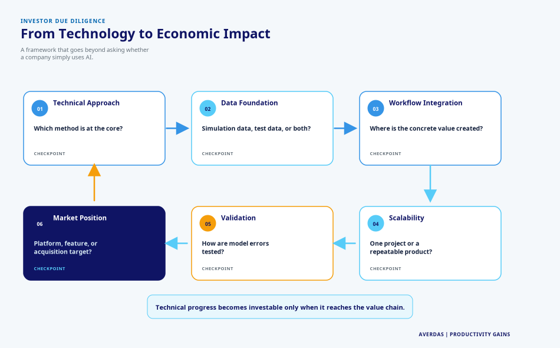
Anyone seeking to assess this productivity lever systematically should not stop at the question whether a company “uses AI.” A multi-stage review framework is more useful.
The six questions
- What technical method is at the core of the business model? A surrogate model is not the same as a digital twin or copilot.
- What data is required? A company with access to proprietary test data may be positioned differently from a provider that relies mainly on publicly available simulation data.
- Where does the workflow improve? The key question is whether the technology improves a central development decision or merely accelerates a small work step.
- How repeatable is the benefit? A scalable software product is economically different from a series of individual consulting projects.
- How are uncertainty and errors controlled? In safety-critical industries, audit trails, explainability, and human-in-the-loop controls are not side issues.
- What role do platform providers play? An independent provider must not only be technologically strong but also compete with the integration power of established software companies.
The risks are not only technological
The development of digital engineering systems involves specific risks. First, a model may perform very well within the data and design spaces it knows but lose predictive value outside those boundaries. Second, integration into existing engineering and manufacturing processes may take longer than developing the model itself.
Third, industries differ substantially. A model for a standardized component may be easier to scale than a solution for a complex, certification-intensive system. Fourth, a productivity gain can be lost elsewhere if manufacturing processes, supply chains, or regulatory requirements do not support the new design.
For investment analysis, the full chain is thereforedecisive:
Model speed → engineering decision → manufacturability → series production → economic impact
If this chain is interrupted at any point, technical progress may fail to generate a corresponding business result.
Conclusion: The real value lies in the number of possibilities
The most important effect of faster digital testing is not that a computer runs one simulation more quickly. The greater lever is that companies can evaluate more options before committing to a physical product.
Some tested variants become a broader search. A static CAD model can become a continuously updated digital twin. A manual design task can become an iterative dialogue between engineer and software.
For institutional investors and asset managers, this area offers a differentiated perspective on corporate productivity. The relevant question is not simply which company uses the most advanced AI. It is this:
Which technology improves the quality and speed of real engineering decisions—and how reliably can that advantage be translated into economic value?
The answer will differ by technology, industry, and business model. That is precisely what makes the category interesting: it connects software, industrial value creation, and measurable productivity improvements—and shows how digital speed can become a physical competitive advantage.
