
Prof. Dr. Leo Brecht


Member of the Board, Partner


Prof. Dr. Leo Brecht
Member of the Board, Partner
Prof. Dr. Leo Brecht is a mathematician and economist with a PhD in mathematical statistics and a professorship in innovation and technology management at the University of Liechtenstein. With over 20 years of experience in management consulting and applied research, and more than 10 years in investment management, he is a leading expert in the fields of innovation, technology and product management. Leo Brecht has supported more than 100 projects for SMEs and multinational companies in various industries, from strategic consulting to technology assessments. He is also the founder of ALPORA, where he and his team have developed innovative investment products that have led to over €700 million in assets under management. Over the last ten years, he has given more than 1,000 investor presentations. He was a partner at Andersen and Arthur D. Little, the author of several books and a conference speaker. As an active investor and serial entrepreneur, he is particularly involved in the FINTECH, SUSTTECH and EDUTECH sectors. In his free time, Leo Brecht is a passionate regatta sailor and skier and enjoys spending time with his family.
The $1.4 Trillion Problem Hiding in Plain Sound
Thisarticle is part three of Averdas' twelve-part series on where corporates can achieve productivity gains, which maps the operational domains where artificial intelligence is delivering measurable efficiency improvements across industry.
Read the series overview: Where Corporates Can Achieve Productivity Gains
Every piece of rotating industrial equipment gives off a warning before it fails. A bearing about to seize vibrates differently weeks before it seizes. A motor about to burn out draws current differently. A pump that is cavitating sounds different long before it stops pumping. For most of industrial history, that warning went unheard—nobody was measuring continuously, and nobody had the pattern-recognition capacity to notice a slow drift buried in noisy sensor data.
That combination—catastrophic cost of failure, a strong physical signal that precedes it, and, until recently, no practical way to listen—is what makes predictive maintenance one of the most extensively documented return-on-investment cases of any industrial AI application. For investors tracking how productivity gains translate into corporate earnings, few domains offer as much verifiable, named evidence.
Why the Numbers Matter
The scale of the underlying problem is what makes the fix valuable. Siemens' 2024 True Cost of Downtime study puts unplanned downtime at roughly $1.4 trillion a year across the world's largest manufacturers—about 11 percent of their annual revenue, up from 8 percent in 2019–2020.
Against that baseline, the documented gains are specific and substantial:
- IBM's Maximo platform has been credited with up to 70 percent fewer breakdowns and 50 percent less downtime at scale.
- GE Aerospace's engine digital twins now flag preventive maintenance needs 60 percent earlier than a decade ago, while halving false alerts over the same period.
- Unilever's Indaiatuba, Brazil, plant cut maintenance expenses by 45 percent after deploying AI across more than 50,000 IoT sensors, recovering its investment in under seven months.
Note for editorial review: These figures are drawn from named corporate case studies and third-party reporting (see Sources below); they should be re-verified against current public disclosures before publication.
A Comparatively Tractable Machine-Learning Problem
What sets predictive maintenance apart from many other AI applications is the nature of the underlying problem. Predicting that a bearing will fail is grounded in known physics, not in inferring human behavior—unlike, say, predicting which marketing campaign will convert a customer. That makes it a comparatively tractable machine-learning difficulty with an unusually strong and immediate financial signal attached to getting it right.
This is likely why predictive maintenance shows more consistent agreement across independent sources—McKinsey, Deloitte, Siemens, the World Economic Forum's Lighthouse Network, and named corporate case studies—than almost any other AI use case in industry.
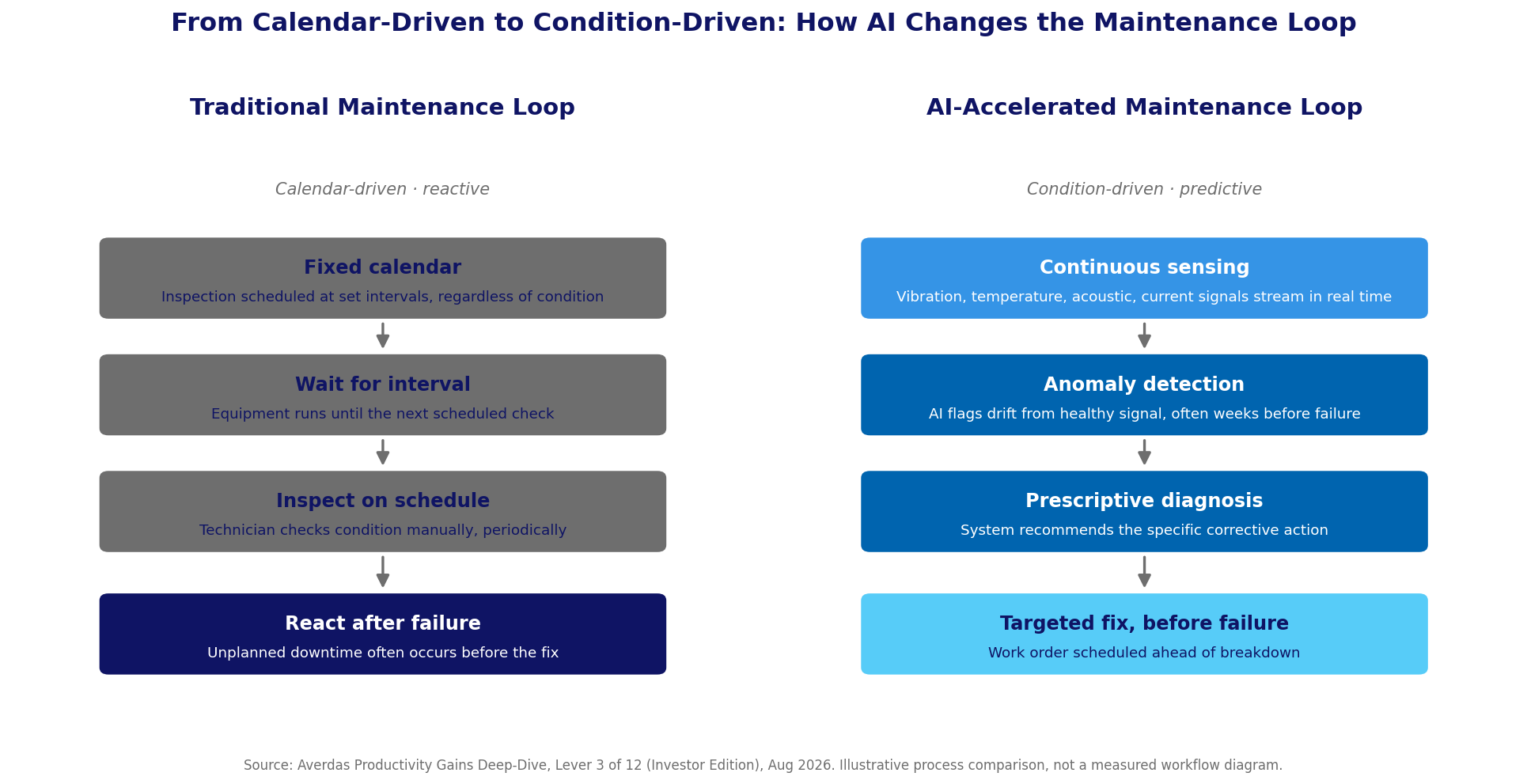
The traditional alternative, an affixed maintenance calendar, is a blunt instrument. It either services equipment more often than necessary, wasting labor and spare parts, or not often enough, risking an unplanned failure that costs far more than the maintenance it was meant to prevent. An AI system that watches conditions continuously replaces that guesswork with an answer grounded in the asset's actual, current state—a shift from calendar-driven to condition-driven operations.
The Technology Stack, Layer by Layer
Vibration sensors and machine learning alerts get most of the attention, but the productivity gain in this domain is delivered by a layered stack. Understanding the layers matters for anyone assessing which companies hold genuinely defensible technology rather than a thin software layer over someone else's hardware.
Listening to the machine—IoT sensor networks. Wireless vibration, temperature, acoustic, and magnetic-flux sensors mounted directly on rotating and static equipment—motors, pumps, compressors, gearboxes—stream condition data continuously, rather than requiring a technician to visit with a handheld device on a fixed schedule. This is the physical layer everything else is built on.
Hearing the failure before it happens—anomaly detection and remaining-useful-life models. Machine-learning models trained on libraries of known failure modes learn what a healthy machine's signal looks like and flag the moment a specific asset starts drifting from it, often weeks before a human would notice anything wrong.
Telling the technician what to do—prescriptive diagnostics. AI systems that go a step past detection and recommend the specific corrective action—replace this bearing, realign this shaft, rebalance this rotor—closing the loop from an abstract anomaly score to a concrete, schedulable work order.
Simulating the asset's whole remaining life—digital twins. Physics-based virtual replicas of high-value equipment—a turbine, a compressor train, an offshore platform—simulate wear and degradation forward in time, letting engineers optimize maintenance across an asset's full remaining life rather than reacting to a single threshold breach.
Bundling sensing and software into one product—integrated hardware-and-AI platforms. A newer category of vendors ships proprietary sensors alongside the AI models and maintenance-management software in a single package, reducing the integration work a plant needs to do. This is compared with stitching together sensors, a data platform, and an analytics layer from three separate vendors.
Three Corporates Already Exploiting the Domain
IBM applies its Maximo asset-management platform, fused with IoT sensor data, both internally and for large industrial clients across manufacturing, utilities, and transportation. IBM has documented deployments achieving up to 50 percent downtime reduction and 70 percent breakdown reduction on combined AI and IoT implementations, illustrating how a legacy enterprise software incumbent has embedded predictive maintenance as a core, revenue-generating capability.
GE Aerospace uses AI-driven digital-twin technology across its jet engine fleet, maintaining a continuously updated virtual replica of each engine's condition. Over the past decade this has delivered a 60 percent earlier lead time on preventive maintenance actions while cutting the rate of false alerts in half—notable for improving both sides of the usual predictive-maintenance trade-off simultaneously.
Unilever deployed AI-driven predictive maintenance across more than 50,000 IoT sensors at its Indaiatuba plant in Brazil. The result: $2.3 million in annual savings and a 45 percent reduction in maintenance expenses, with the $1.2 million investment recovered in under seven months.
.png)
A Consolidating Venture Landscape
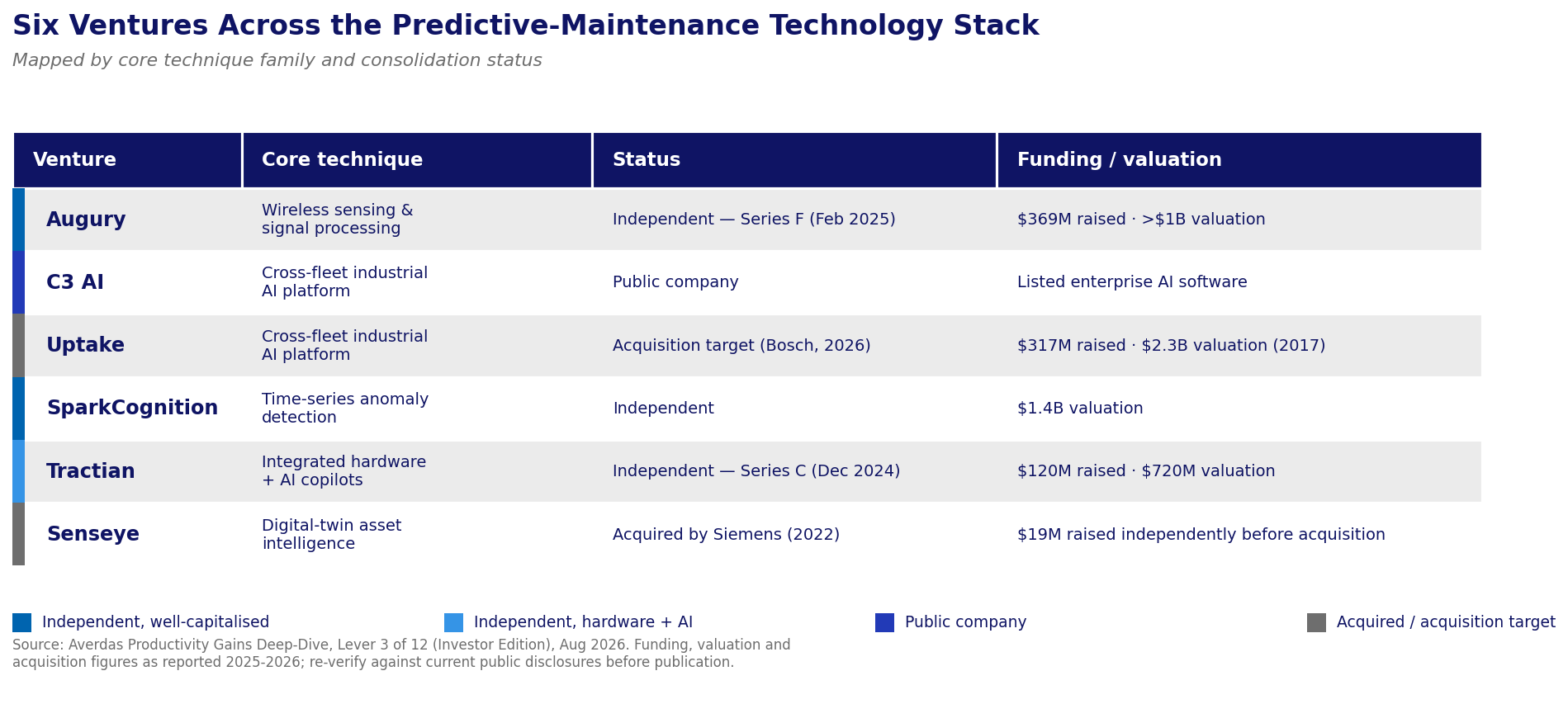
This is one of the more consolidated domains in the productivity-gains landscape. Two ventures profiled in the underlying research are no longer independent: Siemens acquired the UK's Senseye in 2022, and Bosch is acquiring Uptake in 2026—a pattern of large industrial incumbents buying rather than building.
The independents that remain are notably well capitalized. Augury has raised $369 million and maintained a valuation above $1 billion through its February 2025 Series F. Tractian raised $120 million in a December 2024 round at a $720 million valuation, with customers including Bosch, Kraft Heinz, Carrier, and Hyundai. SparkCognition is reported at a $1.4 billion valuation. Unlike some AI ventures that layer software over commodity hardware, several of these companies combine proprietary sensors with their algorithms, which raises the capital bar to compete and makes an installed leader harder to displace.
What This Means for Productivity-Focused Investors
Predictive maintenance is a clear illustration of what Averdas terms "process productivity"—how efficiently operative workflows and procedures translate inputs into economic output—and “resilience productivity,” the ability to sustain performance when conditions change, including unplanned equipment failure. Companies that have moved from calendar-driven to condition-driven maintenance are demonstrating exactly the kind of structural efficiency gain that Averdas' productivity framework seeks to identify and measure across corporate universes.
As with the other eleven domains in this series, the takeaway is not that any single technology delivers the gain on its own. A layered combination of sensing, detection, prescription, and simulation—increasingly consolidated by both incumbents and well-funded independents—is becoming a durable driver of corporate productivity.
