
Ruth Schönleber


Member of the Board, Partner


Ruth Schönleber
Member of the Board, Partner
Ruth Schönleber brings over 30 years of expertise in digital transformation, marketing, and corporate management. As a founding partner and board member of innovative companies like Averdas AG, Invenum GmbH, and ALPORA AG, she develops forward-looking strategies in marketing, sales, and operations. Her career includes leadership roles at Hewlett-Packard and BMC Software, where she excelled in sales, strategic partnerships, and customer management. She has also served as a board member in the tourism sector. With a degree in Business Informatics (FH) and fluency in English, Ruth is a highly regarded consultant and leader in digital business models, innovation management, and strategic planning. An avid sailor and skier, she enjoys spending time with her ambitious hunting dog.
While artificial intelligence (AI) currently dominates market narratives and capital allocation strategies, a comprehensive view of the technological landscape reveals a broader ecosystem of innovation. We are witnessing a convergence of physical hardware, advanced connectivity, and novel computational architectures that promise to redefine productivity standards globally. For institutional investors and wealth managers, recognizing these adjacent technologies is crucial for portfolio diversification and capturing the next wave of industrial alpha.
This analysis explores the emerging technologies operating in tandem with AI—specifically robotics, quantum computing, and advanced connectivity—and how they are revolutionizing industrial output and operational efficiency.

The Robotics Renaissance: From Automation to Autonomy
The industrial sector is undergoing a profound transformation driven by the maturation of robotics technology. We are moving beyond static, caged arms performing repetitive tasks to dynamic, autonomous systems capable of complex interaction within unstructured environments.
Humanoid and Industrial Robotics
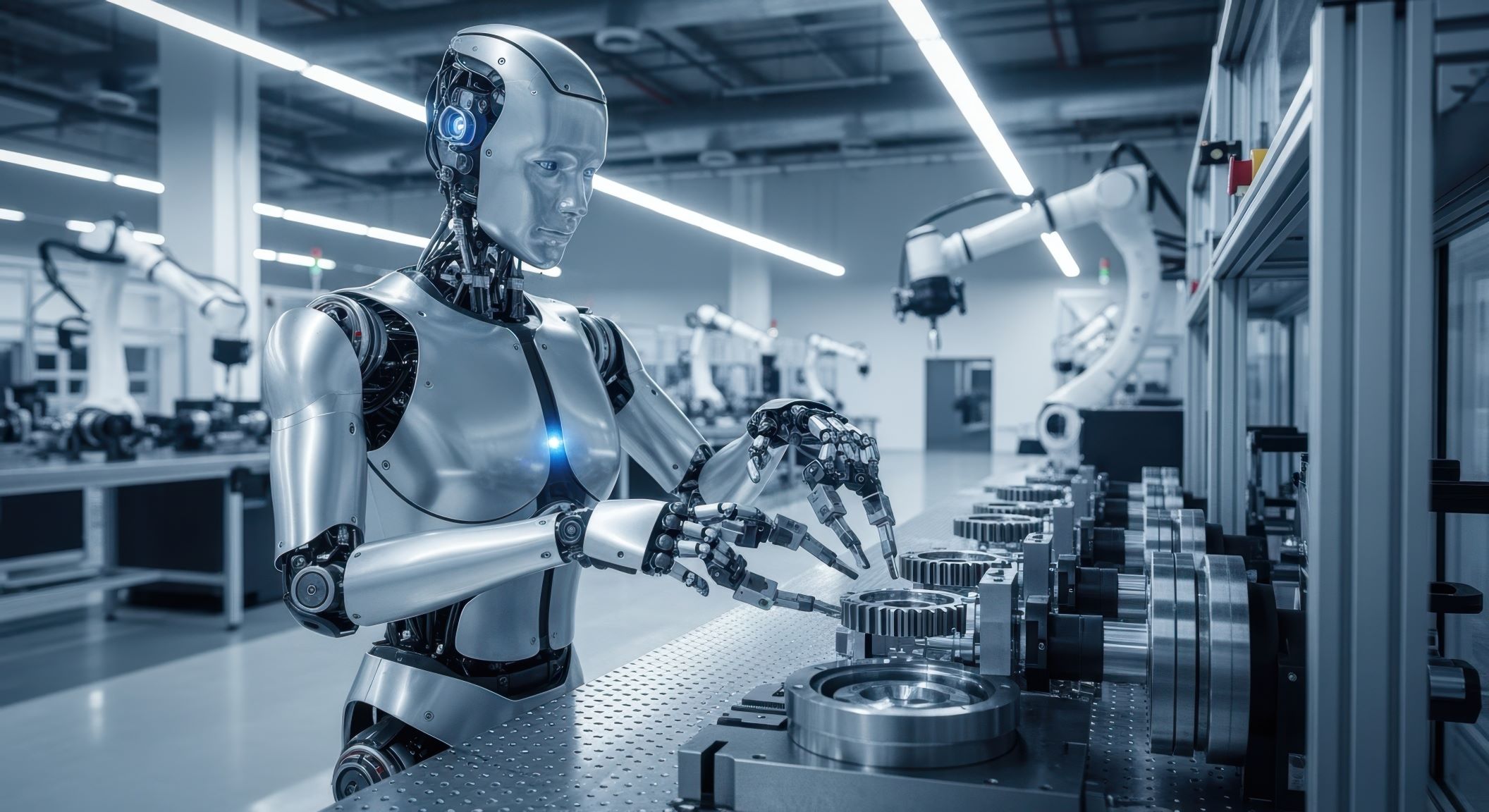
The deployment of humanoid robots represents a significant leap in labor augmentation. Unlike traditional industrial robots designed for specific tasks, humanoid form factors are built to navigate environments designed for humans. Leading automotive manufacturers such as BMW and Tesla are actively integrating humanoid robots into their production lines. These units are not merely replacing human labor but are handling hazardous, ergonomically challenging, or highly repetitive tasks with consistent precision. This shift mitigates operational risk related to labor shortages and workplace safety, directly impacting long-term production stability.
Collaborative and Autonomous Mobile Robots
Collaborative robots (cobots) and autonomous mobile robots (AMRs) are redefining the logistics and manufacturing floor. Cobots are engineered with advanced sensors to work safely alongside human operators, enhancing human capability rather than replacing it. Simultaneously, AMRs utilize sophisticated SLAM (Simultaneous Localization and Mapping) technology to navigate warehouses autonomously, optimizing supply chain throughput without the need for fixed infrastructure like magnetic strips or rails. For investors, this sector offers tangible efficiency gains. The integration of AMRs and cobots allows for flexible manufacturing lines that can adapt rapidly to changing market demands—a critical factor in maintaining competitive advantage.
Quantum Computing: Redefining Computational Limits
While classical computing follows Moore's Law, quantum computing operates on entirely different principles, offering exponential leaps in processing power for specific problem sets.

The Quantum Advantage
Recent advancements have yielded record-breaking quantum bit (qubit) arrays, moving us closer to fault-tolerant quantum computing. This technology excels at optimization difficulties that are currently intractable for classical supercomputers. In the context of finance, this translates to real-time portfolio optimization, complex risk modeling, and cryptographic security enhancements.
The implications for productivity are staggering. Industries relying on material science and chemical discovery can simulate molecular interactions with unprecedented accuracy, drastically reducing the R&D cycle for new drugs or advanced materials.
The Connectivity Backbone: 5G, Wi-Fi 7, and Digital Twins
High-speed, low-latency connectivity is the prerequisite for the modern industrial ecosystem. The rollout of 5G and the introduction of Wi-Fi 7 provide the bandwidth necessary to support massive machine-type communications (mMTC).
Real-Time Data and Digital Twins
This enhanced connectivity enables the proliferation of Digital Twin technology. A digital twin is a virtual replica of a physical asset, process, or system. By leveraging real-time data from IoT sensors transmitted via 5G networks, organizations can simulate performance, predict maintenance needs, and optimize workflows in a virtual environment before implementing them physically.
For asset managers, the digital twin concept allows for granular visibility into the operational health of portfolio companies. It transforms maintenance from a reactive cost center into a predictive, manageable variable, thereby preserving capital and ensuring operational continuity.
Biotechnology: Precision Fermentation and Biofoundries
Productivity innovations extend into the biological realm, where biology is increasingly treated as a manufacturing discipline.

AI-Driven Biofoundries
AI-driven biofoundries are automating the “design-build-test-learn” cycle of synthetic biology. These facilities utilize robotics and machine learning to engineer biological systems at scale. Precision fermentation, a key output of this technology, allows for the production of complex organic molecules—such as proteins or enzymes—without traditional agricultural inputs.
This creates a decoupling of production from land and resource constraints, offering a hedge against climate-related supply chain disruptions. The ability to program microorganisms to produce high-value compounds represents a shift toward biomanufacturing, offering sustainable growth opportunities for forward-looking portfolios.
Sustainable Computing: Neuromorphic Architectures
As the demand for compute power escalates, energy consumption becomes a critical risk factor. The current trajectory of AI model training is energy-intensive, raising concerns regarding environmental impact and operational expenses.
Neuromorphic Computing
Neuromorphic computing addresses this by mimicking the neural structure of the human brain. Unlike the traditional von Neumann architecture, which separates processing and memory, neuromorphic chips integrate them, drastically reducing the energy required to move data.
This architecture is particularly adept at handling sensory data and edge computing tasks with minimal power consumption. Furthermore, advanced algorithms are optimizing water and energy usage in data centers, aligning technological expansion with ESG mandates. We observe a trend where energy efficiency is not just a compliance metric but a core component of operational productivity.
Future Outlook: The Convergence of Technologies
The future of productivity lies not in a single technology but in the convergence of these disparate fields. We envision a manufacturing ecosystem where:
- Quantum algorithms optimize supply chains in real-time.
- Neuromorphic sensors on AMRs process visual data with minimal energy.
- Humanoid robots execute tasks alongside humans, orchestrated by 5G-connected Digital Twins.
- Biofoundries produce sustainable raw materials on demand.
For the professional investor, the value proposition is clear. These technologies reduce marginal costs, enhance resilience against volatility, and open new markets. The next frontier of productivity is about the seamless integration of digital intelligence with physical execution.
Conclusion and Strategic Next Steps
We recommend that investors look beyond the headline hype of generative AI to the infrastructure and hardware enabling this new industrial revolution.
Actionable Next Steps:
- Analyze Portfolio Exposure: Assess current holdings for exposure to robotics, advanced connectivity, and next-gen computing hardware.
- Monitor Regulatory Developments: Stay informed on regulations governing autonomous systems and bioethics, as these will shape market entry barriers.
- Evaluate Integration Capabilities: When vetting potential investments, prioritize companies that demonstrate the ability to integrate these emerging technologies into existing workflows, as implementation is often the primary bottleneck to value realization.
