
Prof. Dr. Leo Brecht


Member of the Board, Partner


Prof. Dr. Leo Brecht
Member of the Board, Partner
Prof. Dr. Leo Brecht is a mathematician and economist with a PhD in mathematical statistics and a professorship in innovation and technology management at the University of Liechtenstein. With over 20 years of experience in management consulting and applied research, and more than 10 years in investment management, he is a leading expert in the fields of innovation, technology and product management. Leo Brecht has supported more than 100 projects for SMEs and multinational companies in various industries, from strategic consulting to technology assessments. He is also the founder of ALPORA, where he and his team have developed innovative investment products that have led to over €700 million in assets under management. Over the last ten years, he has given more than 1,000 investor presentations. He was a partner at Andersen and Arthur D. Little, the author of several books and a conference speaker. As an active investor and serial entrepreneur, he is particularly involved in the FINTECH, SUSTTECH and EDUTECH sectors. In his free time, Leo Brecht is a passionate regatta sailor and skier and enjoys spending time with his family.
In October 2024, the AlphaFold team was awarded the Nobel Prize in Chemistry. This is more than just a footnote for this series: it is the only formal confirmation to date from the scientific community itself that an AI model does not merely speed up an existing task. It solves a research problem that for decades was regarded as a discipline in its own right—predicting the three-dimensional structure of proteins from their sequence. What used to take years of experimental crystallography can now be calculated in minutes.
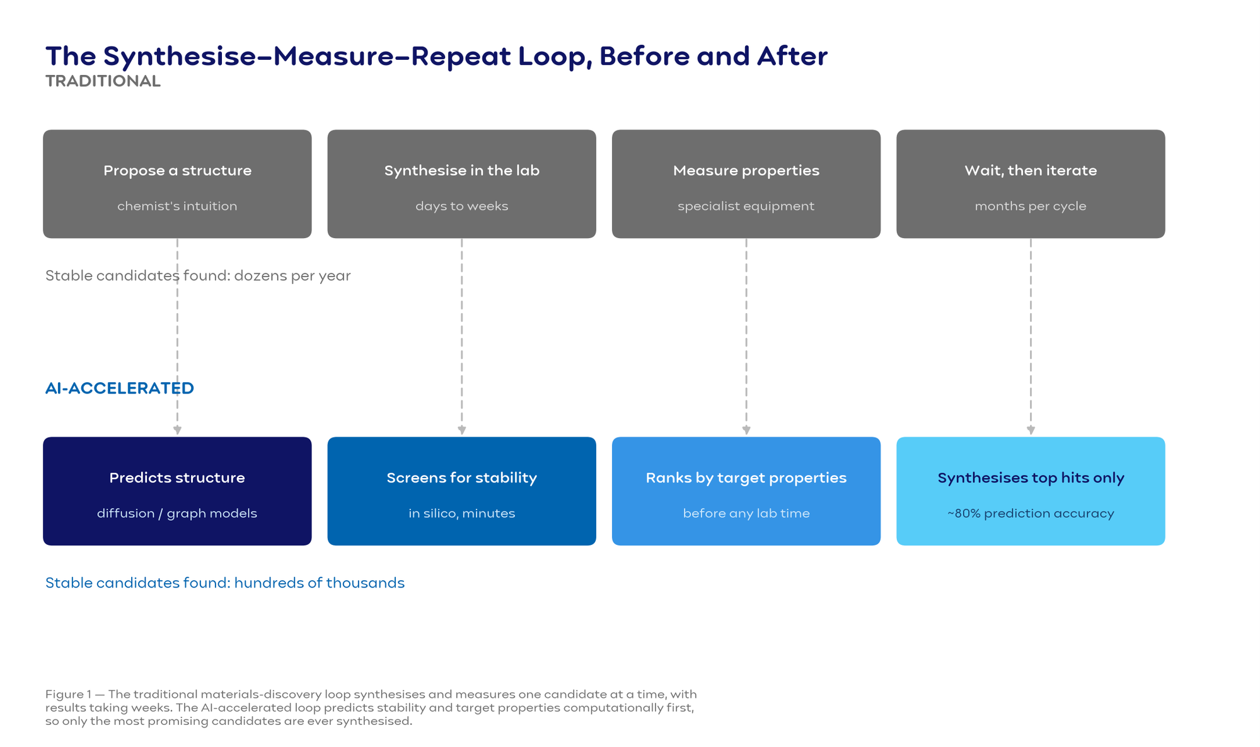
Material science is at the earliest stage of development in this twelve-lever series—but, according to the underlying briefing’s own assessment, it is also the field with the highest ceiling. The reason lies in the underlying mechanism: the space of possible inorganic crystal structures or drug-like molecules is so vast that even a well-equipped laboratory can only ever synthesize and test a vanishingly small fraction of it. AI does not remove this constraint by making the laboratory faster, but by screening or generating candidates computationally before a single one ever reaches physical synthesis. This is precisely why the time savings reported in this field—80 to 95 percent in peer-reviewed computational-materials studies—are among the largest documented anywhere in this series.
The Toolkit: Four Building Blocks, One Principle
Public attention tends to focus on the most spectacular figures—millions of newly identified materials. The actual productivity gain, however, arises from the interplay of several technique families:
- Closed-loop discovery workflows link machine-learning surrogate models directly to autonomous synthesis and testing, closing the gap between prediction and physical proof.
- Protein and molecular structure prediction (the AlphaFold lineage) predicts three-dimensional structures from sequence data at near-experimental accuracy—the achievement recognized by the 2024 Nobel Prize in Chemistry.
- Generative materials-design platforms propose novel candidates directly from a target-property specification, rather than searching an existing database.
- AI-guided synthesis-condition prediction estimates temperature, precursor ratios, and reaction time to close the so-called "synthesis gap": the distance between a material that is thermodynamically stable on a computer and one that can actually be made in alab.
Three Corporate Examples With Verifiable Figures
Three examples from peer-reviewed Nature publications illustrate how differently this approach is being implemented.
Google DeepMind—GNoME. The model, published in Nature in 2023, screened candidates for inorganic crystal structures and identified 2.2 million new materials, of which 380,000 were assessed as stable enough for synthesis—more than eight times the number of stable materials previously discovered through conventional methods. The model achieves roughly 80 percent accuracy in predicting material stability, compared with roughly 50 percent for prior computational approaches. To date, external laboratories have independently synthesized 736 of the predicted structures—a small fraction of the total, reflecting the pace of experimental validation rather than a weakness in the model.
Microsoft — MatterGen. Published in Nature in January 2025, MatterGen takes a structurally different approach: rather than screening a fixed pool of candidates, it generates entirely novel crystal structures from scratch using a diffusion model—the same underlying mathematical framework used in image generators—tailored to a target property.
Lawrence Berkeley National Laboratory—The A-Lab. Over seventeen days of largely unsupervised operation, the A-Lab combined AI-proposed synthesis recipes with robotic experimentation to synthesize 36 of 57 attempted novel compounds. Worth noting for context: an independent analysis published after the original Nature paper prompted a downward correction to the originally reported figures—a reminder that even peer-reviewed results in this fast-moving field warrant ongoing critical scrutiny rather than being taken at face value indefinitely.
Where Private Capital Can Actually Participate
For capital allocators, this domain shows the clearest split in this entire series between corporate-research-lab-driven breakthroughs and venture-backed commercialization. The two most consequential technologies, GNoME and MatterGen, are internal research projects at Google DeepMind and Microsoft, respectively—not venture-backed or publicly listed companies with an investable capital structure. Independent venture activity has instead concentrated in the layers around that core, where capital requirements are lower and differentiation is more a matter of domain-specific workflow than raw model scale.

Citrine Informatics has raised approximately US$81 million and reached a US$140 million valuation, underpinned by patented methods that let R&D teams evaluate whether a given design space contains improved materials before running a single physical experiment. Customers include 3M, Panasonic, and Autodesk.
Kebotix, with US$23.7 million raised from investors including Novo Holdings, integrates cloud computing, machine learning, physical modelling, and robotic automation into a closed-loop discovery platform—a smaller-scale, commercially available variant of the closed-loop principle the A-Lab demonstrates at a national-laboratory scale.
Schrödinger (NASDAQ: SDGR) is one of the few publicly listed companies in this domain, combining physics-based molecular-dynamics simulation with predictive modelling for pharmaceutical and materials-science customers.
Context for Institutional Investors
For investors who factor technological productivity drivers into their analysis, the relevant distinction is not the drama of the headline figures but the capital structure behind them: where a breakthrough originates inside a technology company’s internal research division, it cannot be accessed directly through a capital allocation. Investable substance instead arises where specialized companies occupy patent-protected niches around these core technologies—in laboratory automation, synthesis prediction, or physics-based simulation. This article describes a technological trend; it is not an investment recommendation regarding any company named above.
