

Article
The value of a biotech platform is measured by what it can dotwice
Biotechnology companies are often valued around a single breakthrough: one molecule, one approval, or one initial commercial indication. The more demanding question is what happens next. Can the company extend the same scientific foundation into additional diseases, reuse established development capabilities, and finance the next wave of innovation from a growing commercial base?
argenx is a biotechnology company focused on severe autoimmune diseases. Its flagship product, VYVGART (also known as VYVGART Hytrulo), blocks the neonatal Fc receptor and thereby reduces disease-relevant IgG autoantibodies. According to the company, argenx generated product revenues of approximately 2.8 billion U.S. dollars and a profit of approximately 838 million U.S. dollars in the first half of 2026. This commercial revenue base enables the company to finance research, regulatory expansions, and new pipeline programs from its ongoing operations.
For investors, this distinction matters. Scientific potential is only one part of the equation. The quality of a biotechnology asset also depends on how effectively a company can deploy capital, processes, people, and commercial infrastructure across multiple opportunities.

Asset productivity: extending a validated scientific foundation
argenx demonstrates asset productivity by not limiting VYVGART to a single disease. The same FcRn technology, which is already being used in several indications, is being applied to other autoimmune diseases. In August, argenx reported positive topline results from the Phase 3 ALKIVIA study in autoimmune myositis. The study included 264 patients; according to the company, the primary endpoint was met and a statistically significant treatment benefit was observed. The detailed results are to be presented at a medical conference.
What is particularly attractive is that there is no need to develop an entirely new active ingredient or build a separate commercial infrastructure. Clinical experience, manufacturing processes, dosage forms, and marketing infrastructure can be leveraged across multiple indications. This increases the value per unit of research capital, while the existing platform unlocks additional revenue potential. The focus for further development is now on regulatory approval and the detailed analysis of the study data. With the acquisition of Forte Biosciences, which was completed on August 27, argenx also expanded its asset portfolio to include FB102, an anti-CD122 antibody.
The candidate targets T- and NK-cell activity, thereby complementing the FcRn approach with a second immunological mechanism. FB102 is being investigated for conditions including celiac disease and vitiligo. The transaction expands long-term growth opportunities by adding a complementary immunological approach. FB102 is being investigated for conditions including celiac disease and vitiligo; further clinical data are expected to clarify the program’s potential applications and commercial potential.
Process productivity: Scalable development and commercialization
Argenx’s process productivity stems from the reuse of development and commercialization processes. New indications for VYVGART can build on a known mechanism of action, existing safety data, an established dosage form, and an existing global organization. This does not automatically shorten the time to market, but it does reduce the additional organizational and operational burden compared to developing an entirely new product.
ALKIVIA was conducted globally with the participation of partners such as Zai Lab. In this way, argenx leverages external resources to expand its clinical reach and tap into key markets. The subcutaneous formulation VYVGART Hytrulo also enables a more efficient and patient-friendly administration than intravenous therapy. The resulting potential for improved patient care and broader use serves as a lever for process productivity, though it is not a separately reported corporate metric.
.png)
A relevant productivity lever is the data-driven prioritization of indications and development programs. At argenx, productivity gains result from the systematic analysis of clinical data, the selection of promising areas of application, and the faster transfer of validated processes. The more efficient use of clinical and regulatory resources is crucial.
Resilience productivity: Financial strength and a broader growth base
The combination of recurring VYVGART revenues, high liquidity, and multiple clinical development programs gives argenx a high degree of strategic resilience. The company can finance the expansion of its pipeline from a strong commercial foundation and deploy its scientific, clinical, and commercial resources across multiple growth areas. In addition to VYVGART and FB102, argenx is developing, among other things, Empasiprubart, Adimanebart, and other antibody programs.
The Forte acquisition adds another immunological mechanism of action to the portfolio, thereby broadening long-term growth opportunities. Together with the positive ALKIVIA data, this creates an increasingly diversified development base that opens up additional opportunities for argenx to explore new indications. The focus is now on the regulatory implementation of the myositis data, the continued sales growth of VYVGART, and the clinical progress of FB102.
The investor question: Can productivity become compounding growth?
Current developments demonstrate how argenx is leveraging its commercially established FcRn platform to develop further growth opportunities. VYVGART is already generating significant revenue; positive ALKIVIA data open up an additional area of application without requiring an entirely new platform. FB102 expands strategic options by introducing a second immunological approach, thereby strengthening the outlook for an increasingly diversified portfolio.
These three productivity drivers are directly interlinked: Using the same drug platform across multiple indications increases asset productivity; reusing clinical and commercial structures improves process productivity; and the combination of ongoing revenue, high liquidity, and a broader pipeline strengthens resilience. For investors, the key question is whether argenx can continue to translate these productivity advantages into revenue growth, increased profitability, and additional value-creating indications. The regulatory approval of the myositis data, the clinical development of FB102, and the continued revenue momentum of VYVGART represent the most important upcoming milestones in this regard.
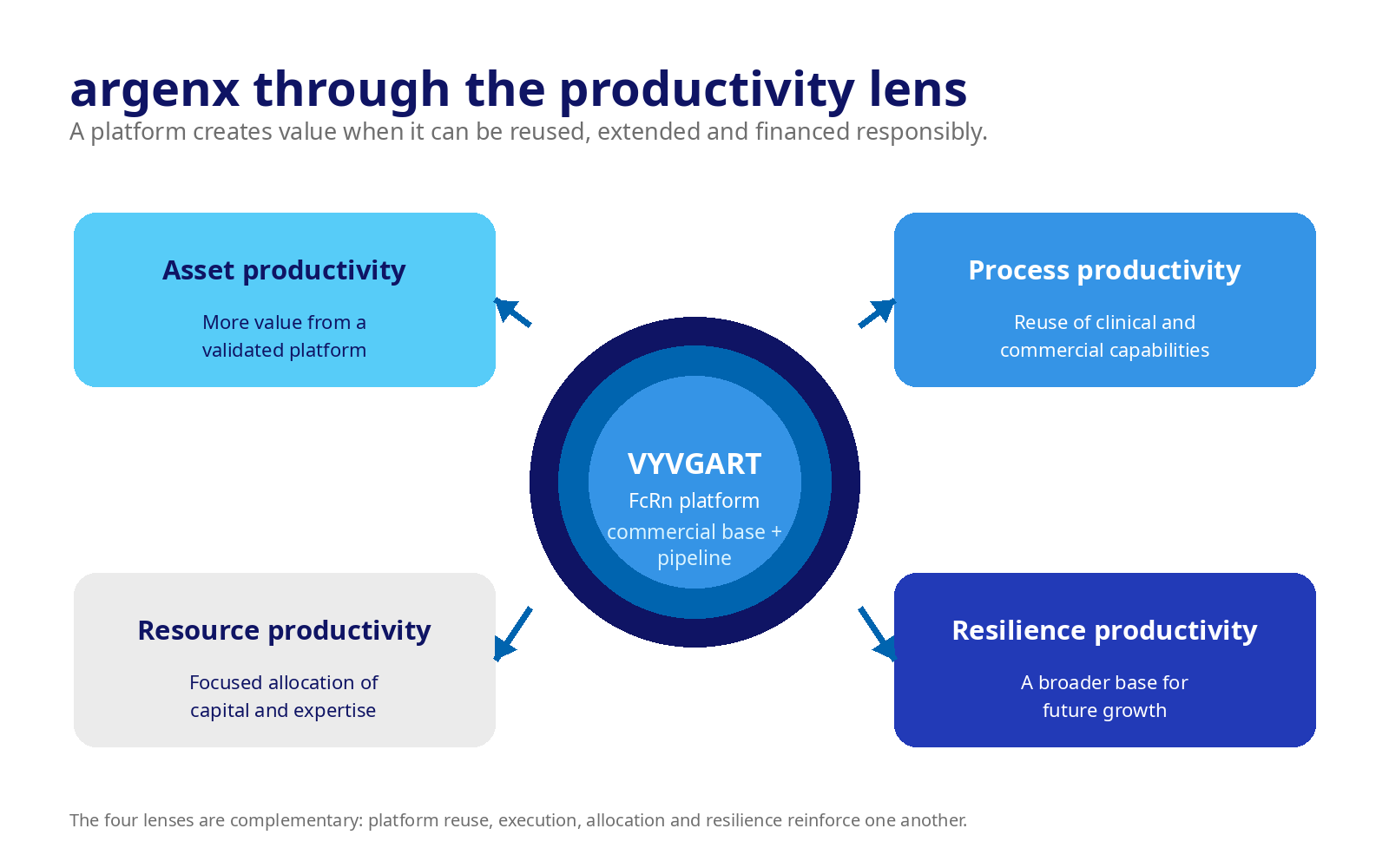
The next milestones will test whether this logic translates into durable economic value. These include the regulatory path for the autoimmune myositis data, the ongoing commercial performance of VYVGART, and clinical progress for FB102. The central issue is not simply whether argenx can add more programs. It is whether the company can scale its platform without diluting scientific focus, operational discipline, or capital efficiency.
For investors assessing productivity leaders, that is the more durable measure of progress: not the number of assets on a pipeline slide, but the amount of future opportunity the organization can create from the capabilities it already owns.